
Technology
Scientific Approach
Scientific Approach

Leveraging novel technologies
uniquely suited to the eye

ATSENA’S proprietary AAV technology platform is purpose-built for inherited retinal disease. Our two core technologies, a novel laterally spreading capsid, AAV.SPR, and dual vector technology, are each designed to overcome biological barriers that have historically limited gene therapy in the eye. AAV.SPR enables efficient gene delivery to the central retina, including the fovea, without the surgical risks of foveal detachment. Our dual vector technology enables treatment of diseases caused by genes too large to package in a single AAV vector. Together, these platforms are engineered disease by disease with the goal deliver the right gene to the right cells, and to do so safely and effectively.

Our technologies are uniquely suited for the prevention or reversal of blindness. We utilize an AAV capsid, payload and delivery approach that is engineered for each disease, and our AAV vectors are designed for delivery via subretinal or intravitreal injection.

Laterally Spreading Capsids

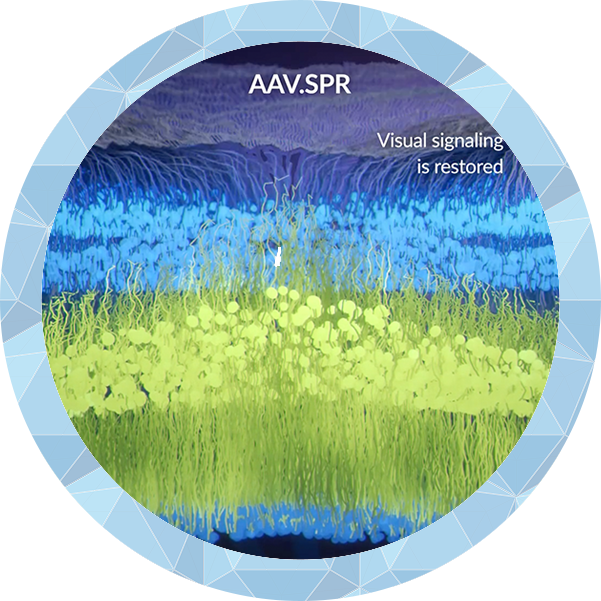
AAV.SPR, our novel laterally spreading capsid, designed to enable safe and efficient gene delivery to the central retina, is the foundation of our XLRS, USH1B, and Stargardt disease programs. In patients with XLRS, AAV.SPR has demonstrated the ability to spread beyond the subretinal injection site and deliver gene therapy to the fovea without the need for surgical foveal detachment.

LEARN MORE

Dual Vector Technology

Some inherited retinal diseases are caused by genes too large to fit inside a single AAV vector. Our dual vector technology overcomes this barrier by splitting the therapeutic gene across two vectors. Upon co-infection of cells with both vectors, the gene fragments recombine, enabling full-length protein expression. Both our MYO7A Usher Syndrome 1B and ABCA4 Stargardt disease programs combine dual vector technology with AAV.SPR, our laterally spreading capsid, enabling full-length gene delivery to photoreceptors throughout the central retina from a peripheral subretinal injection site.

LEARN MORE

accessibility optionsAccessibility
Text Size
A
A