
Technology
Dual Vector Technology

Dual vector technology
unlocks gene therapy for diseases previously beyond reach

Some of the most prevalent inherited retinal diseases are caused by mutations in genes too large to fit inside a single adeno-associated virus (AAV) vector, placing them out of reach for conventional gene therapy approaches. Atsena’s dual vector technology overcomes this barrier. By splitting the therapeutic gene across two separate AAV vectors that recombine at the DNA level upon co-delivery, Atsena’s approach enables robust expression of full-length protein.
Our dual vectors are constructed to deliver larger payloads for genetic mutations that are too large to treat with a single AAV vector.

Credit: MoA animation by Visual Science, 2022

Atsena is applying dual vector technology in two programs: ATSN-301 for MYO7A-associated Usher Syndrome Type 1B (USH1B), and ATSN-401 for ABCA4-associated Stargardt disease. In both cases, the therapeutic gene exceeds the packaging capacity of a single AAV vector. Both programs also leverage AAV.SPR, Atsena’s laterally spreading capsid, enabling gene delivery to photoreceptors throughout the central retina from a peripheral injection site, without the need for surgical detachment of the macula.

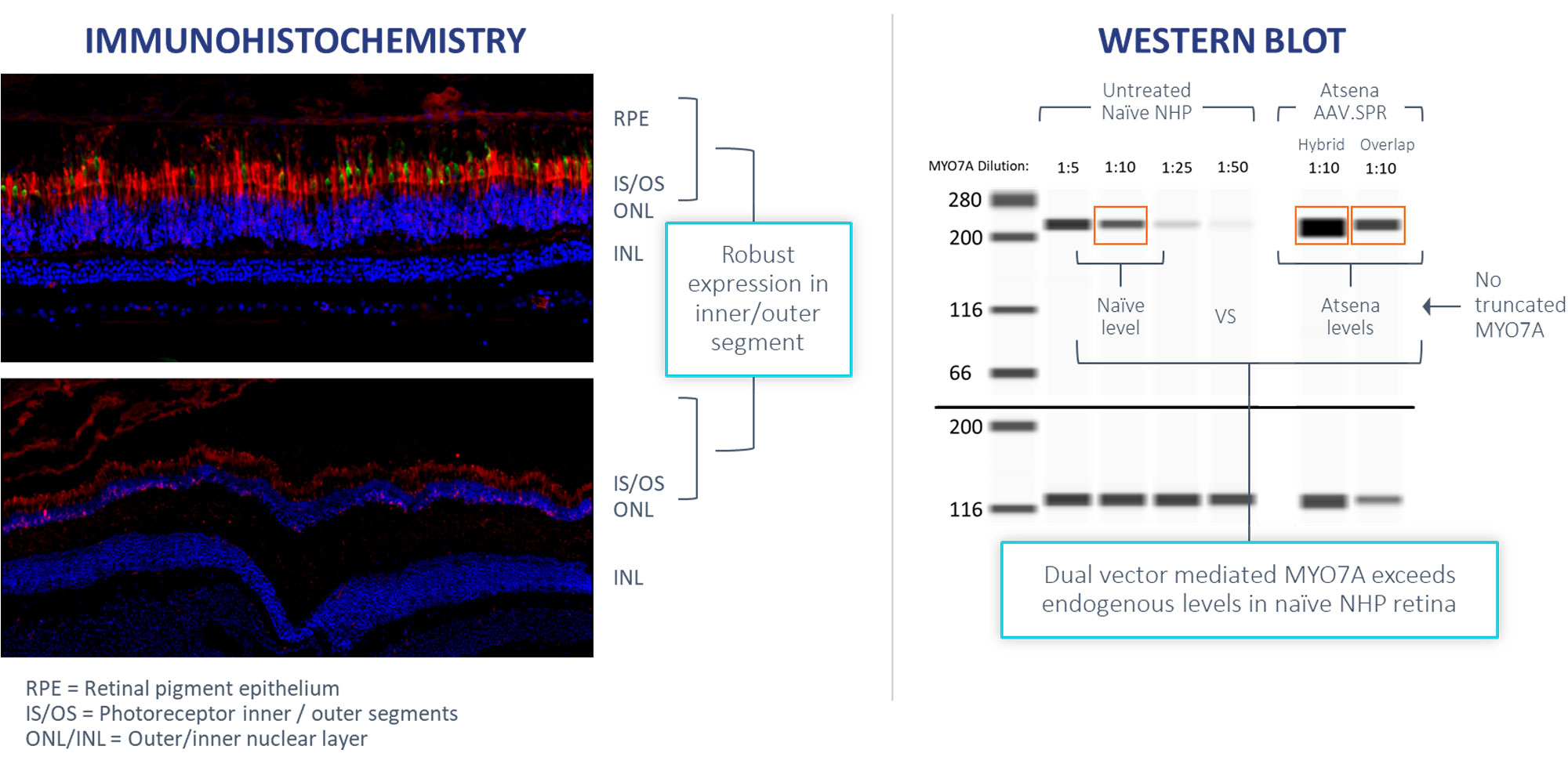
Preclinical studies have demonstrated above-wildtype MYO7A expression in non-human primate retina following peripheral subretinal injection of ATSN-301, supporting its advancement toward clinical application. For ATSN-401, preclinical studies in mouse and non-human primate models demonstrated robust, properly localized ABCA4 expression, meaningful reduction of toxic bisretinoid compounds, and a manageable safety profile with minimal expression of truncated products, supporting the program’s best-in-class potential. Atsena has selected a lead clinical candidate for ATSN-401 and is advancing in IND-enabling studies.


Our dual vectors generate normal levels of expression in non-human primate retina


accessibility optionsAccessibility
Text Size
A
A